
The clock every computer runs on, slow enough to see
A 555 timer ticking about once a second, one LED on the high half and one on the low half. A computer clock you can watch.
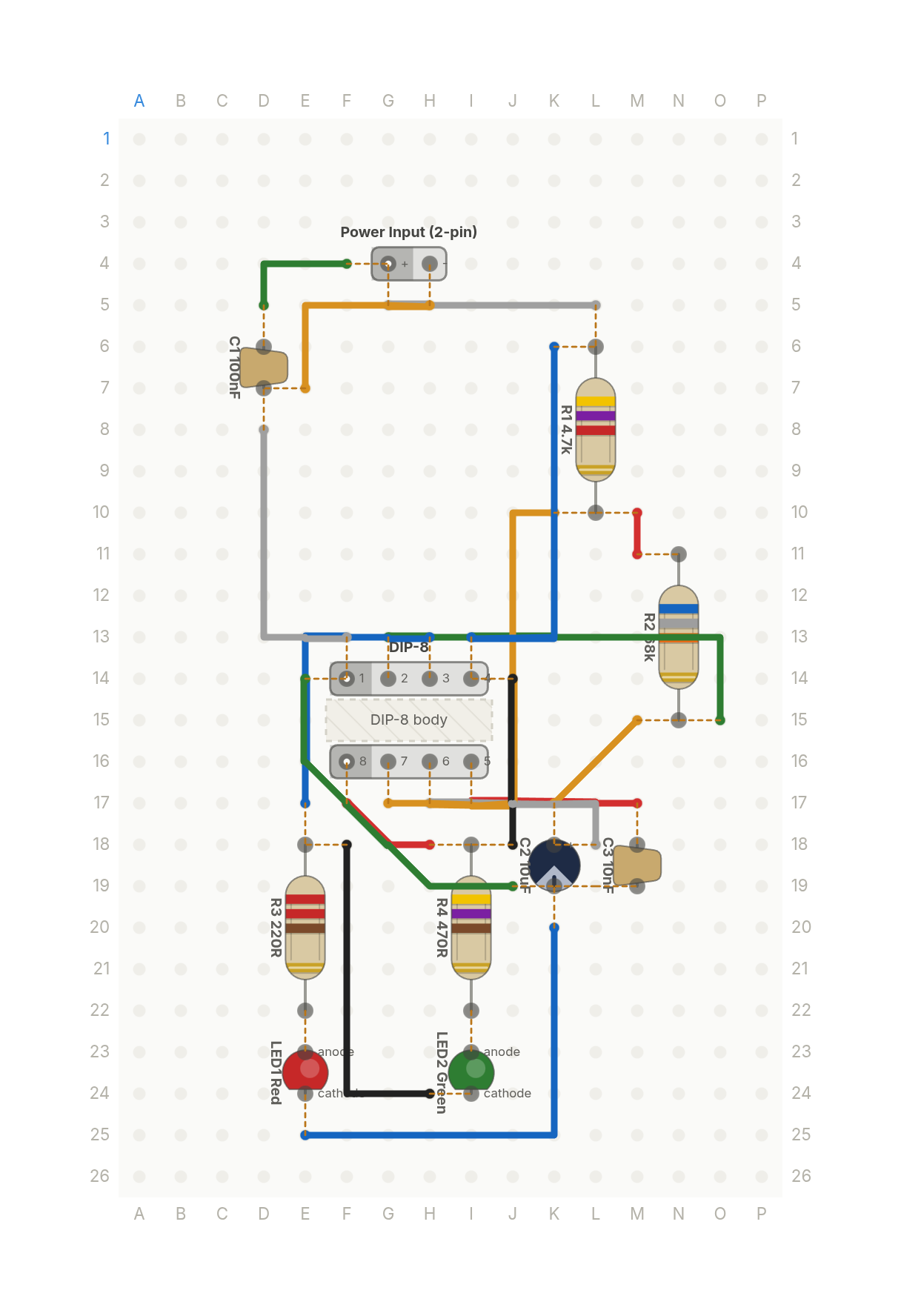
Free build sheet
The parts, every wire with its length and bend points, a bend guide, both sides of the board and checkboxes to track your progress. Print it or keep it open at the bench.
Open the build sheetWhat you need
11 parts on a perfboard 16 × 26 holes, plus hookup wire.
| Qty | Part | Where to buy |
|---|---|---|
| 1 | Ceramic Cap100nF C1 | Buy Ceramic Cap on Amazon |
| 1 | Electrolytic Cap10uF C2 | Buy Electrolytic Cap on Amazon |
| 1 | Ceramic Cap10nF C3 | Buy Ceramic Cap on Amazon |
| 1 | Power Input (2-pin) J1 | |
| 1 | LEDRed LED1 | Buy LED on Amazon |
| 1 | LEDGreen LED2 | Buy LED on Amazon |
| 1 | Resistor (axial)4.7k R1 | Buy Resistor (axial) on Amazon |
| 1 | Resistor (axial)68k R2 | Buy Resistor (axial) on Amazon |
| 1 | Resistor (axial)220R R3 | Buy Resistor (axial) on Amazon |
| 1 | Resistor (axial)470R R4 | Buy Resistor (axial) on Amazon |
| 1 | DIP-8 U1 |
Check every pin against the datasheet of the exact part in your hands before wiring.
As an Amazon Associate I earn from qualifying purchases.
Cut list
17 wires, 433 mm (17.0 in) in total, in the order the build sheet cuts them. Wire numbers match the build sheet. Each length includes 5 mm per end to go through the hole.
| Wire | Colour and net | Length | ||
|---|---|---|---|---|
| 12 | BlackVCC J14 → J18 | J14 → J18 | 20mm | Straight |
| 6 | BlackCLK F18 → H24 | F18 → H24 | 30mm | 20mm (90°) |
| 5 | BlueCLK E17 → H13 | E17 → H13 | 28mm | 15mm (90°) |
| 11 | BlueVCC K6 → I13 | K6 → I13 | 33mm | 23mm (90°) |
| 17 | BlueGND K20 → E25 | K20 → E25 | 38mm | 18mm (90°) |
| 10 | GreenVCC F4 → D5 | F4 → D5 | 18mm | 10mm (90°) |
| 16 | GreenGND E14 → J19 | E14 → J19 | 31mm | 10mm (45°), 21mm (45°) |
| 4 | GreenTIMING O15 → G13 | O15 → G13 | 35mm | 10mm (90°) |
| 7 | RedDISCH M10 → M11 | M10 → M11 | 13mm | Straight |
| 13 | RedVCC H18 → F17 | H18 → F17 | 16mm | 8mm (45°) |
| 1 | RedCONT M17 → I17 | M17 → I17 | 20mm | Straight |
| 3 | WhiteTIMING L18 → H17 | L18 → H17 | 23mm | 8mm (90°) |
| 9 | WhiteVCC L5 → G5 | L5 → G5 | 23mm | Straight |
| 15 | WhiteGND D8 → F13 | D8 → F13 | 28mm | 18mm (90°) |
| 2 | YellowTIMING M15 → K17 | M15 → K17 | 17mm | Straight |
| 14 | YellowGND H5 → E7 | H5 → E7 | 23mm | 13mm (90°) |
| 8 | YellowDISCH K10 → G17 | K10 → G17 | 38mm | 8mm (90°), 25mm (90°) |
About this build
Every computer has a heartbeat. This is one slowed down until you can watch it: a 555 timer wired as an astable clock, ticking about once a second, with a red LED on the high half of the cycle and a green one on the low half.
A 10uF capacitor charges through a 4.7k and a 68k resistor, then discharges through the 68k alone. So the output spends about 0.50 s high and about 0.47 s low. That's 1.03 Hz on paper. The clock in a laptop does the same job about three billion times a second.
A 100nF cap bypasses the supply, a 10nF cap steadies the control input, and the LEDs get 220 and 470 ohm resistors. This is the clock for a longer series where an AI agent builds a CPU on perfboard.
More builds
See all builds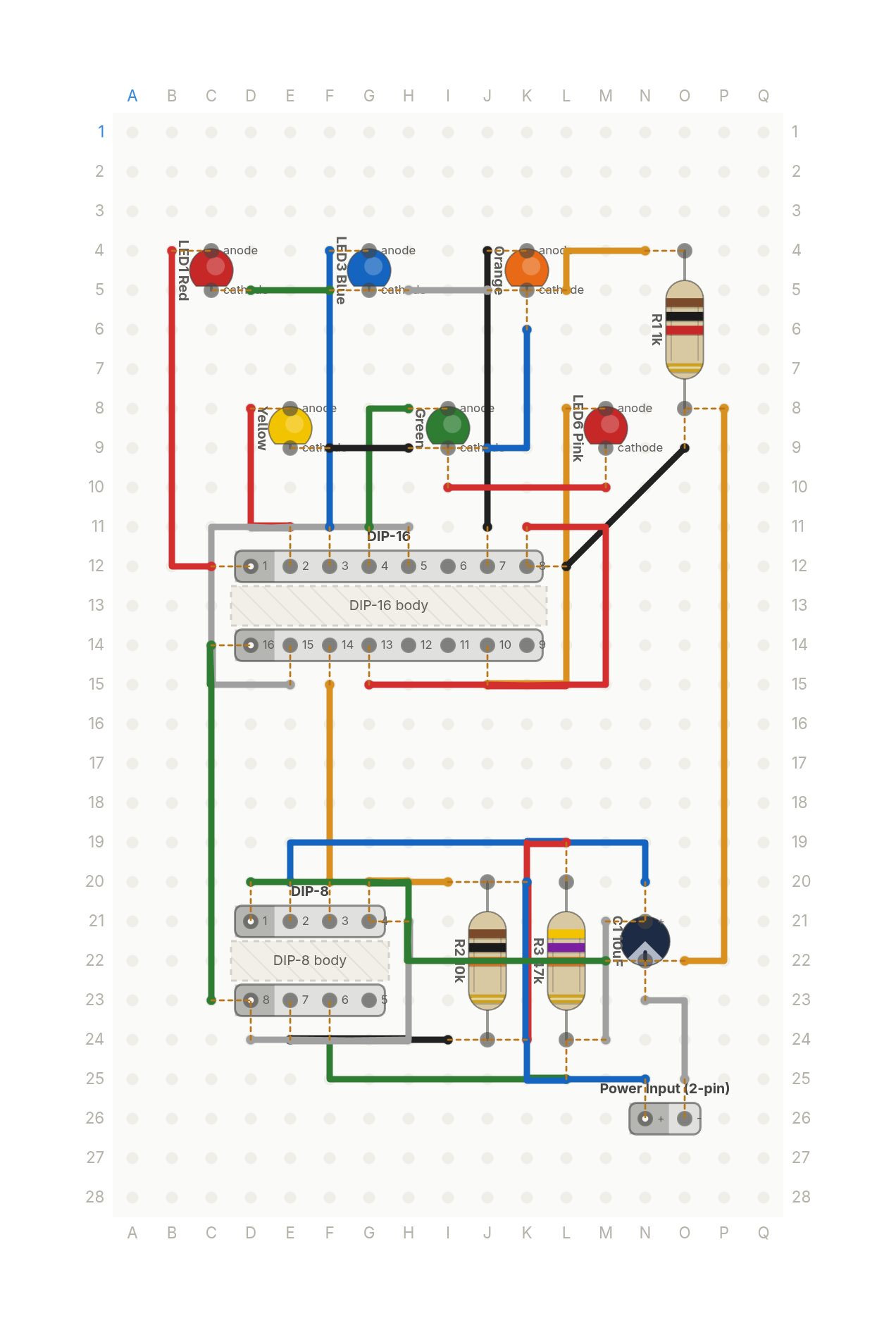 Video
VideoThe Stranger Things light wall, from two chips
Six coloured LEDs light one at a time in a loop, like the Christmas light wall in Stranger Things. A 555 timer and a counter.
13 parts · 28 wires
LightsTimers and logic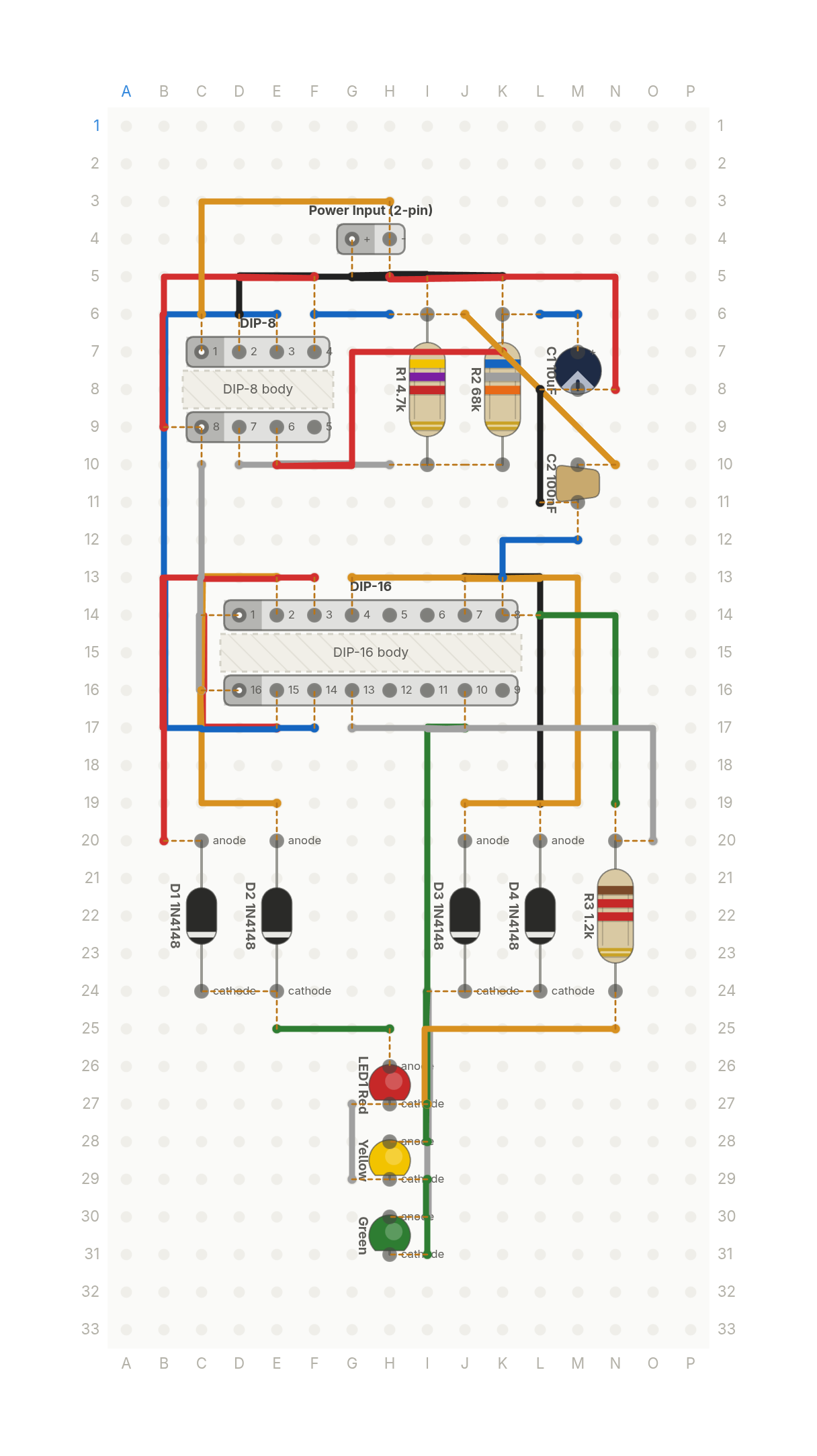 Video
VideoA traffic light that counts to five
Red, yellow and green LEDs that cycle like a traffic light on their own. A 555 timer, a decade counter and four diodes.
15 parts · 27 wires
LightsTimers and logic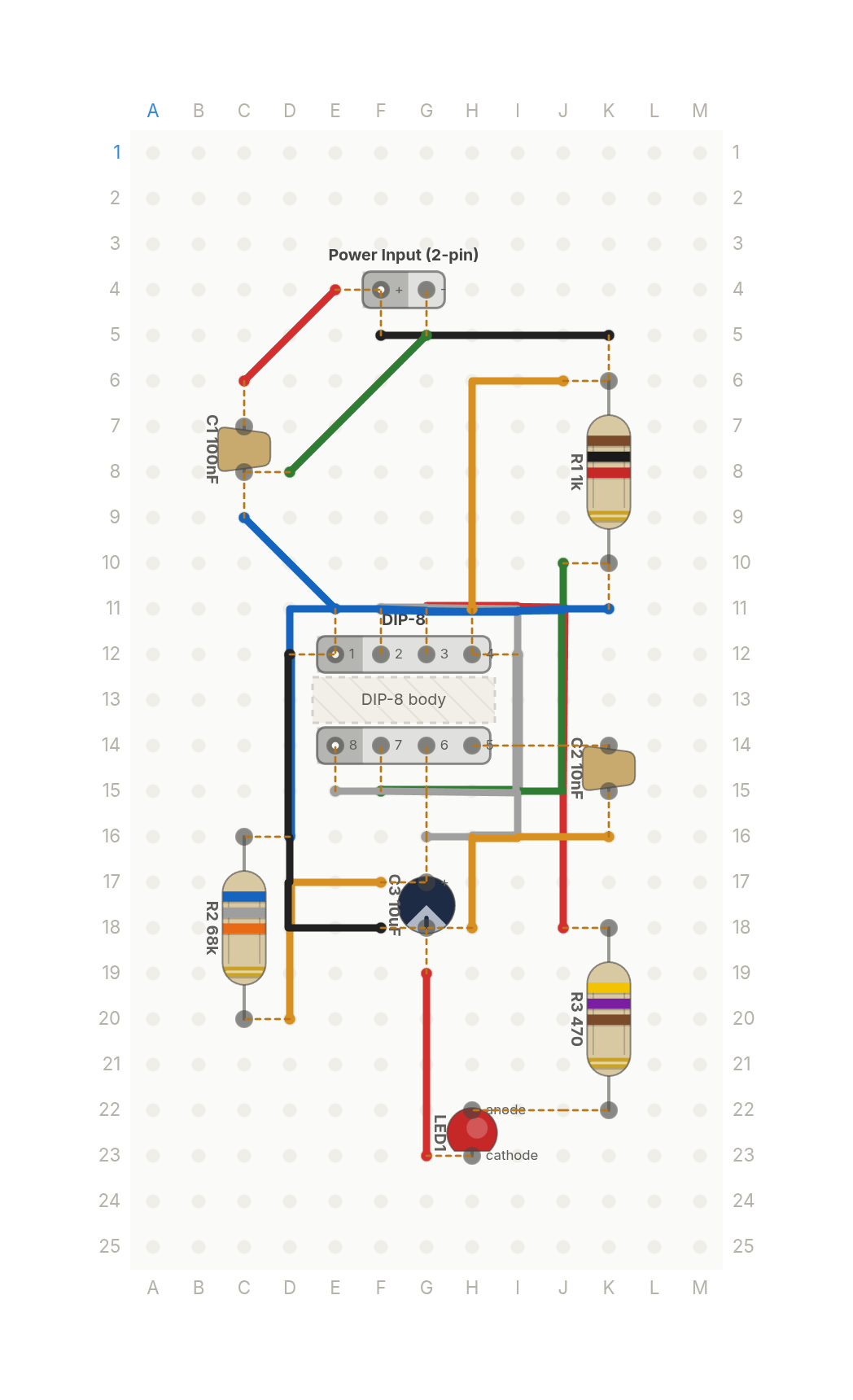 Video
VideoThe most famous chip in electronics
The 555 timer doing its classic job: blinking an LED about once a second. A good first build.
9 parts · 14 wires
Timers and logicLights